

BY STEPHANIE ESLAKE
Hope and Bravery.
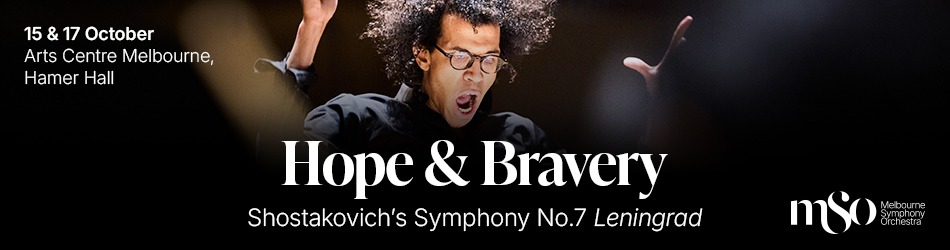
This is the name of the upcoming concert program with musicians of the Melbourne Symphony Orchestra, which features Shostakovich’s Symphony No.7 Leningrad and Tomasi’s Saxophone Concerto.
It’s also a phrase that describes the qualities of classical saxophonist Steven Banks.
Steven has built his career advocating for an instrument that is not traditionally found in an orchestra.
On top of that, he advocates for something that would be brave for any musician to prioritise in a performance: the uninhibited expression of self. To Steven, performance is about more than just mastering the instrument. It’s also about being who you are, and choosing to share that – in all its vulnerability – from your position on the stage and behind it, too.
“I think that music is inherently a form of self-expression…the idea of expressing technical artistry to me is simply a byproduct,” Steven tells CutCommon.

It’s an approach Steven brings into his role as Associate Professor of Saxophone at the Cleveland Institute of Music, through which he encourages students to understand how “the internal desire to create powerful moments can only truly come from personal experience”.
He brings it into his advocacy; through his writing and lectures, Steven has celebrated the history of Black composers and has fostered talks supporting the LGBTQIA+ community and women in classical music.
Personal expression is also an approach Steven brings directly into his performances, whether he’s standing with his saxophone on the stage of the Melbourne Symphony Orchestra (making his debut in October, no less) or the San Francisco Symphony, Colorado Symphony, or Cleveland Orchestra.
“The best works and performers are always focused on the human element of creating the music – whether it’s connecting with the composer and what they intended, and what they were trying to express about their humanity; or whether it’s writing your own piece, and sorting through the human experience through music.”

Steven’s bravery is found where he breaks down the barriers to self-expression — and that includes choosing the saxophone to play with an orchestra when the repertoire is historically limited.
The saxophone was invented in the mid-19th Century, so every famous (and widely programmed) symphony that came before had no place for it, a fact that continues in concert halls and the very make-up of the orchestra today.
After its invention, Steven says the saxophone could fill an important role with its “unique ability to project over an orchestra as a solo instrument”.
“It was invented to be a bridge between woodwinds and brass; to have the projection of a brass instrument with the nimbleness of a woodwind instrument,” Steven shares.
“So, as a solo voice, I think that’s very effective ‘cause the orchestra can play full and the saxophone can still be heard, and sort of lead the experience.”
As a solo instrument, the saxophone is today known and used for its expressive qualities which, as you could imagine, makes it a perfect fit for Steven.
“I know that everyone says that their instrument sings like the human voice, but I think that the saxophone also has the ability to sing in its own unique way.”

Steven uses the instrument as a medium to share his own voice in music, but he’s also a composer who understands what it means to write for saxophone. In Hope and Bravery, Steven brings this insight into the solo role of Henri Tomasi’s 1949 Saxophone Concerto.
“I love Tomasi’s Saxophone Concerto. I think it’s one of our most cherished pieces of standard repertoire in the saxophone literature,” Steven says.
As a composer whose own music has been premiered at Carnegie Hall, Steven approaches this concerto as a performer who also possesses a particularly discerning eye for the notes on the page.
“As a composer, I think it’s extremely well orchestrated, and uses the medium of the orchestra very well while also leaving a lot of room for the saxophone to be the soloist and never be overpowered,” Steven notes.
“It’s very French in its use of colour and the melodic structures that that people will hear. It’s also very well written for the saxophone: it uses the different ranges of the instrument very idiomatically. And just, as a piece, it has a really wide expressive scope.”
He says the composition ranges from moments that feel “really quirky and almost cheeky” to “militaristic” through the composer’s use of percussion.
“There are even moments that are a little bit groovy,” he adds.
That last observation might suit the public perception of the saxophone as a modern instrument that’s more commonly associated with popular 20th-Century styles (especially jazz). But that’s also a perception that Steven is working to expand as part of his personal mission to “broaden the public view of the saxophone and its expressive qualities”.
“I would almost say 100 percent of the time that I perform, someone comes up afterwards, just saying: ‘I had no idea the saxophone could even sound like that’.
“So there’s much work to be done. And a lot of it is just exposing people to the repertoire that we do have while also continuing to build the repertoire.”
Steven’s performance of the Tomasi concerto will undoubtedly help fulfil that mission for some concertgoers: “It will bring them the sound of the classical saxophone for the first time, which is always exciting.”

The concerto also marks Steven’s break-out performance with the Melbourne Symphony Orchestra, and with conductor Jonathon Heyward.
“It will be a wonderful chance to make new musical friends, both in the orchestra and on the podium.”
Alongside the Tomasi Concerto – written after the composer had served in the French Army – will be Shostakovich’s Seventh, composed during the Siege of Leningrad, and a time of tragedy.
Steven tells us what the concert’s title Hope and Bravery mean to him.
“For me right now, ‘hope’ I think might be the belief that things can get better within ourselves, and outside of ourselves.
“And I think that ‘bravery’ is having the courage and fortitude to act in accordance with that hope.”
Experience Hope and Bravery with saxophonist Steven Banks, guest conductor Jonathon Heyward and the musicians of the MSO. Concerts take place at 7.30pm October 15, and 2pm October 17 in Hamer Hall.

Images supplied.
Have your say.